Selected Works
Tianjian Li, Jingyu Zhang, William Jurayj, Xi Wang, Chuanyang Jin, Mehrdad Farajtabar, Eric Nalisnick, Daniel Khashabi
NeurIPS 2026 · Code
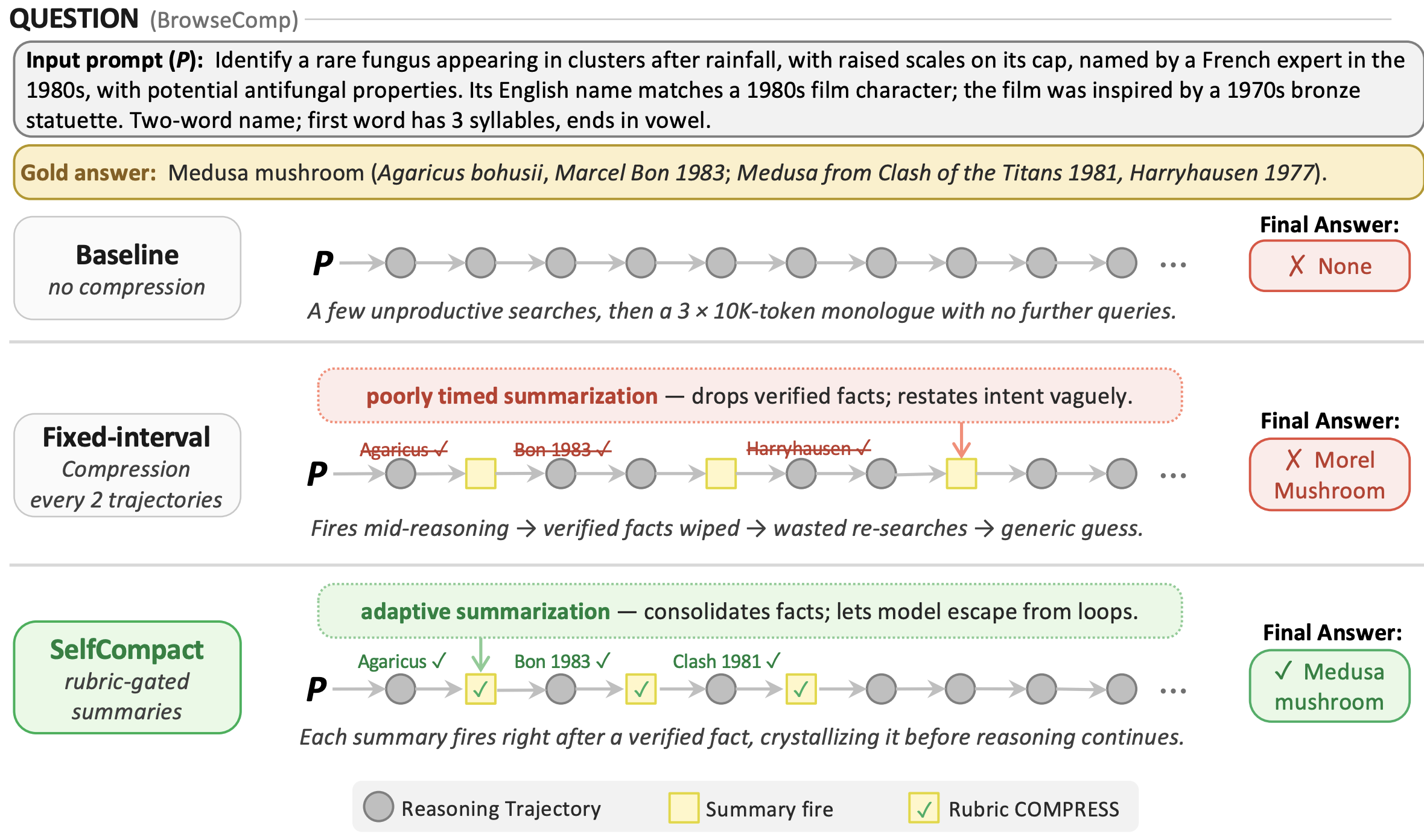
We let the model itself decide when and how to compact its own context, pairing a compaction tool with a lightweight rubric for when to fire and when to hold off. This self-compaction matches or beats fixed-interval summarization while using 30-70% less context budget.
Tianjian Li, Jingyu Zhang, Ping Yu, Swarnadeep Saha, Sainbayar Sukhbaatar, Jason Weston, Ilia Kulikov, Jack Lanchantin
arXiv preprint
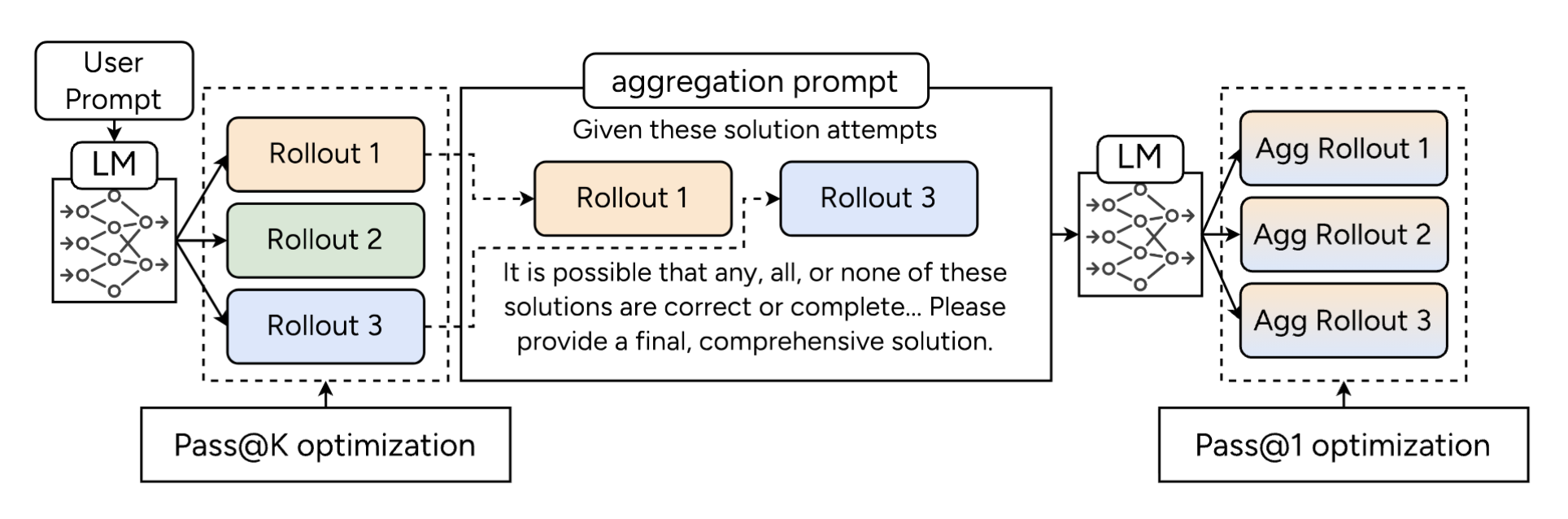
We study parallel reasoning, where a generator proposes multiple candidate solutions and an aggregator synthesizes them into a final answer. ParaGator trains both stages together end-to-end: the generator is optimized for diverse candidates with pass@k while the aggregator is optimized with pass@1, yielding large gains on competition math and scientific reasoning.
Tianjian Li, Yiming Zhang, Ping Yu, Swarnadeep Saha, Daniel Khashabi, Jason Weston, Jack Lanchantin, Tianlu Wang
NeurIPS 2026 · Code
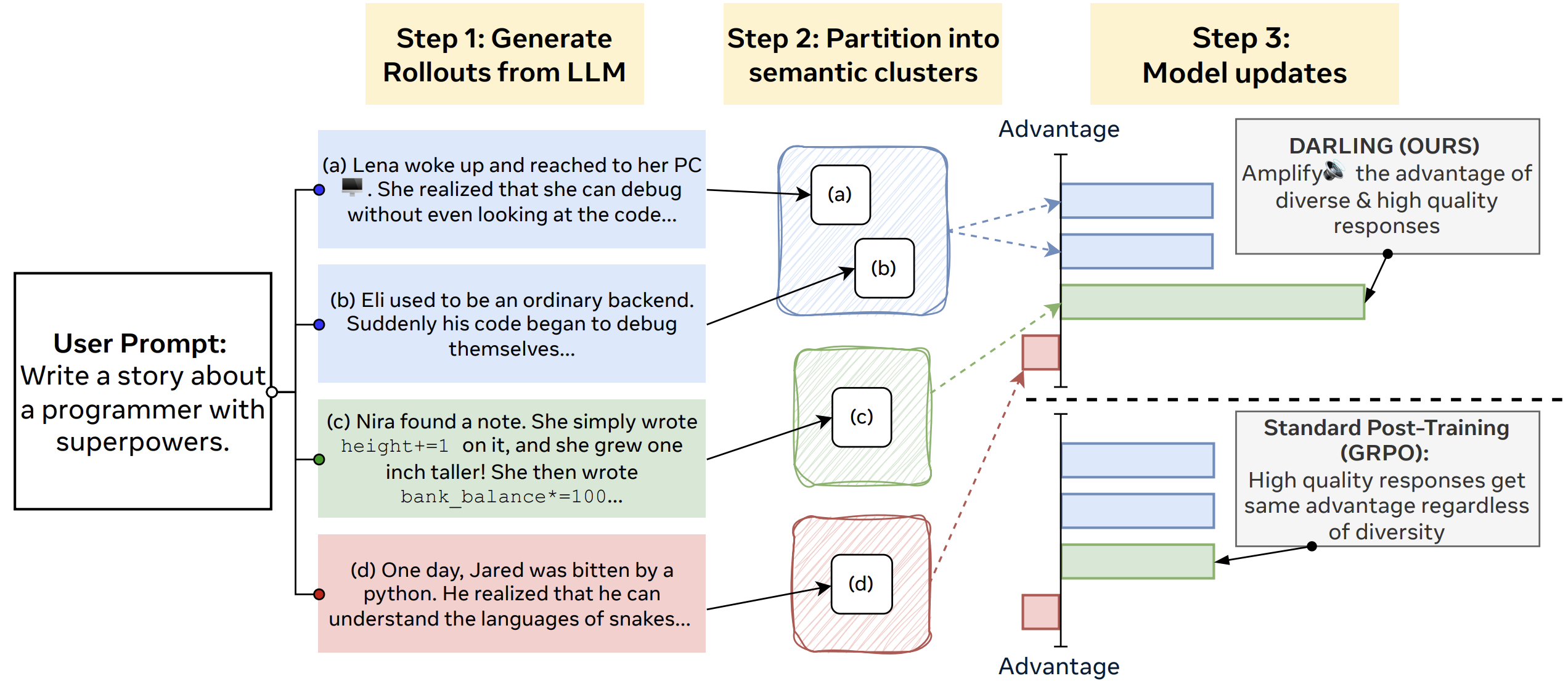
We propose Darling, an online reinforcement learning method that jointly optimizes for the diversity and quality of language model generations. Darling encourages models to produce varied outputs without sacrificing correctness, improving performance on open-ended generation tasks.
Tianjian Li, Haoran Xu, Philipp Koehn, Daniel Khashabi, Kenton Murray
ICLR 2024. Spotlight Presentation - Top 5% · Code
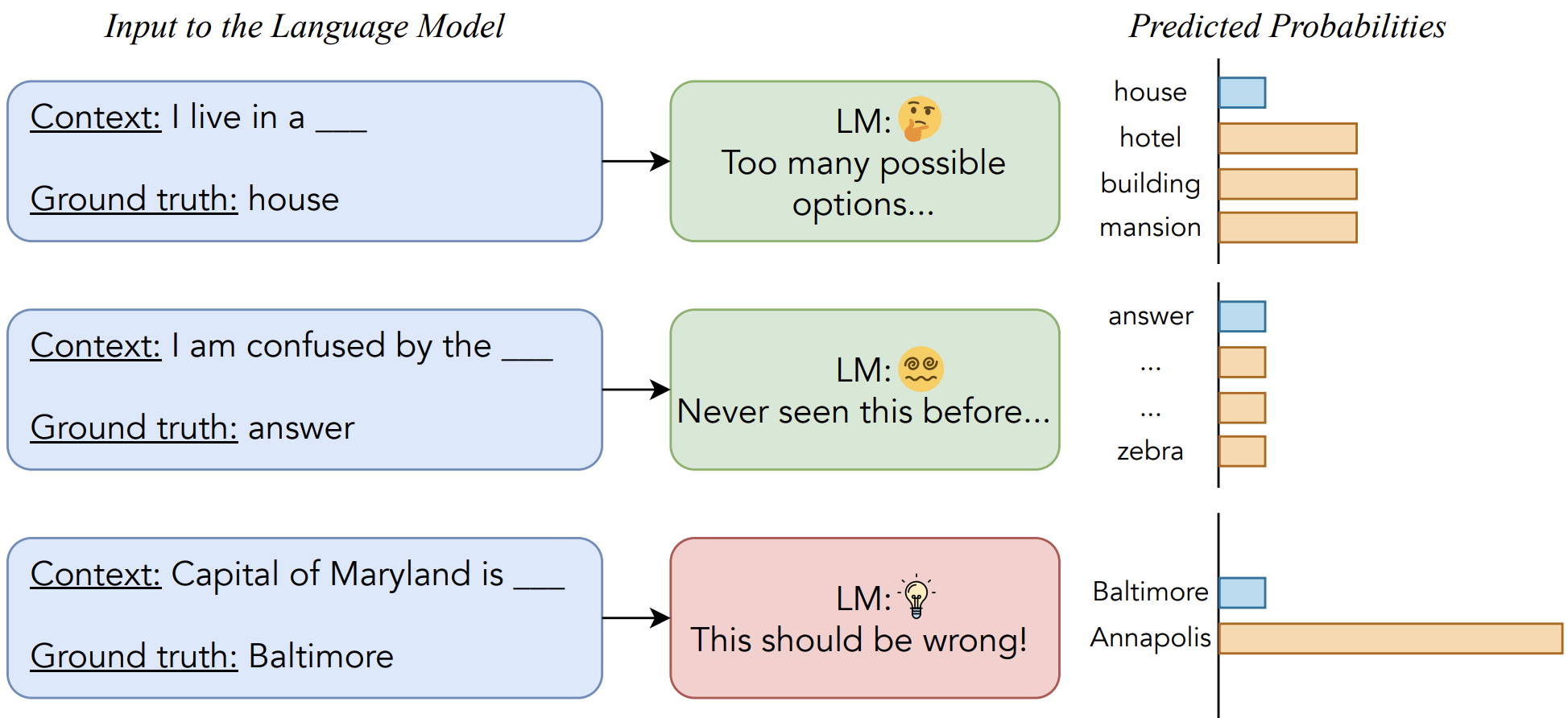
We propose Error Norm Truncation, a robust training objective that down-weights noisy training examples using a more accurate estimate of sample quality than the loss alone. It improves the quality and robustness of text generation models across machine translation, summarization, and language modeling.
Full Publications
Self-Compacting Language Model Agents. Tianjian Li, Jingyu Zhang, William Jurayj, Xi Wang, Chuanyang Jin, Mehrdad Farajtabar, Eric Nalisnick, Daniel Khashabi. NeurIPS 2026.
ThoughtTrace: Understanding User Thoughts in Real-World LLM Interactions. Chuanyang Jin, Binze Li, Haopeng Xie, Cathy Mengying Fang, Tianjian Li, Shayne Longpre, Hongxiang Gu, Maximillian Chen, Tianmin Shu. Best Paper Award, RLxF Workshop, ICML 2026.
Many-Tier Instruction Hierarchy in LLM Agents. Jingyu Zhang, Tianjian Li, William Jurayj, Hongyuan Zhan, Benjamin Van Durme, Daniel Khashabi. EMNLP 2026 (Findings).
Reasoning over Mathematical Objects: On-Policy Reward Modeling and Test Time Aggregation. Pranjal Aggarwal, Marjan Ghazvininejad, Seungone Kim, Ilia Kulikov, Jack Lanchantin, Xian Li, Tianjian Li, Bo Liu, Graham Neubig, Anaelia Ovalle, Swarnadeep Saha, Sainbayar Sukhbaatar, Sean Welleck, Jason Weston, Chenxi Whitehouse, Adina Williams, Jing Xu, Ping Yu, Weizhe Yuan, Jingyu Zhang, Wenting Zhao. arXiv preprint.
Jointly Reinforcing Diversity and Quality in Language Model Generations. Tianjian Li, Yiming Zhang, Ping Yu, Swarnadeep Saha, Daniel Khashabi, Jason Weston, Jack Lanchantin, Tianlu Wang. NeurIPS 2026.
The Translation Barrier Hypothesis: Multilingual Generation with Large Language Models Suffers from Implicit Translation Failure. Niyati Bafna, Tianjian Li, Kenton Murray, David R. Mortensen, David Yarowsky, Hale Sirin, Daniel Khashabi. IJCNLP-AACL 2025.
The Flaw of Averages: Measuring Benchmark-Level Distributional Robustness. Arda Uzunoglu, Tianjian Li, Daniel Khashabi. EMNLP 2026.
SIMPLEMIX: Frustratingly Simple Mixing of Off- and On-policy Data in Language Model Preference Learning. Tianjian Li, Daniel Khashabi. ICML 2025.
Upsample or Upweight? Balanced Training on Heavily Imbalanced Datasets. Tianjian Li, Haoran Xu, Weiting Tan, Kenton Murray, Daniel Khashabi. NAACL 2025.
Benchmarking Language Model Creativity: A Case Study on Code Generation. Yining Lu, Dixuan Wang, Tianjian Li, Dongwei Jiang, Daniel Khashabi. NAACL 2025.
Verifiable by Design: Aligning Language Models to Quote from Pre-Training Data. Jingyu Zhang, Marc Marone, Tianjian Li, Benjamin Van Durme, Daniel Khashabi. NAACL 2025.
Error Norm Truncation: Robust Training in the Presence of Data Noise for Text Generation Models. Tianjian Li, Haoran Xu, Philipp Koehn, Daniel Khashabi, Kenton Murray. ICLR 2024. Spotlight Presentation - Top 5%.
Why Does Zero-shot Cross-lingual Generation Fail? An Explanation and A Solution. Tianjian Li, Kenton Murray. ACL 2023 (Findings).